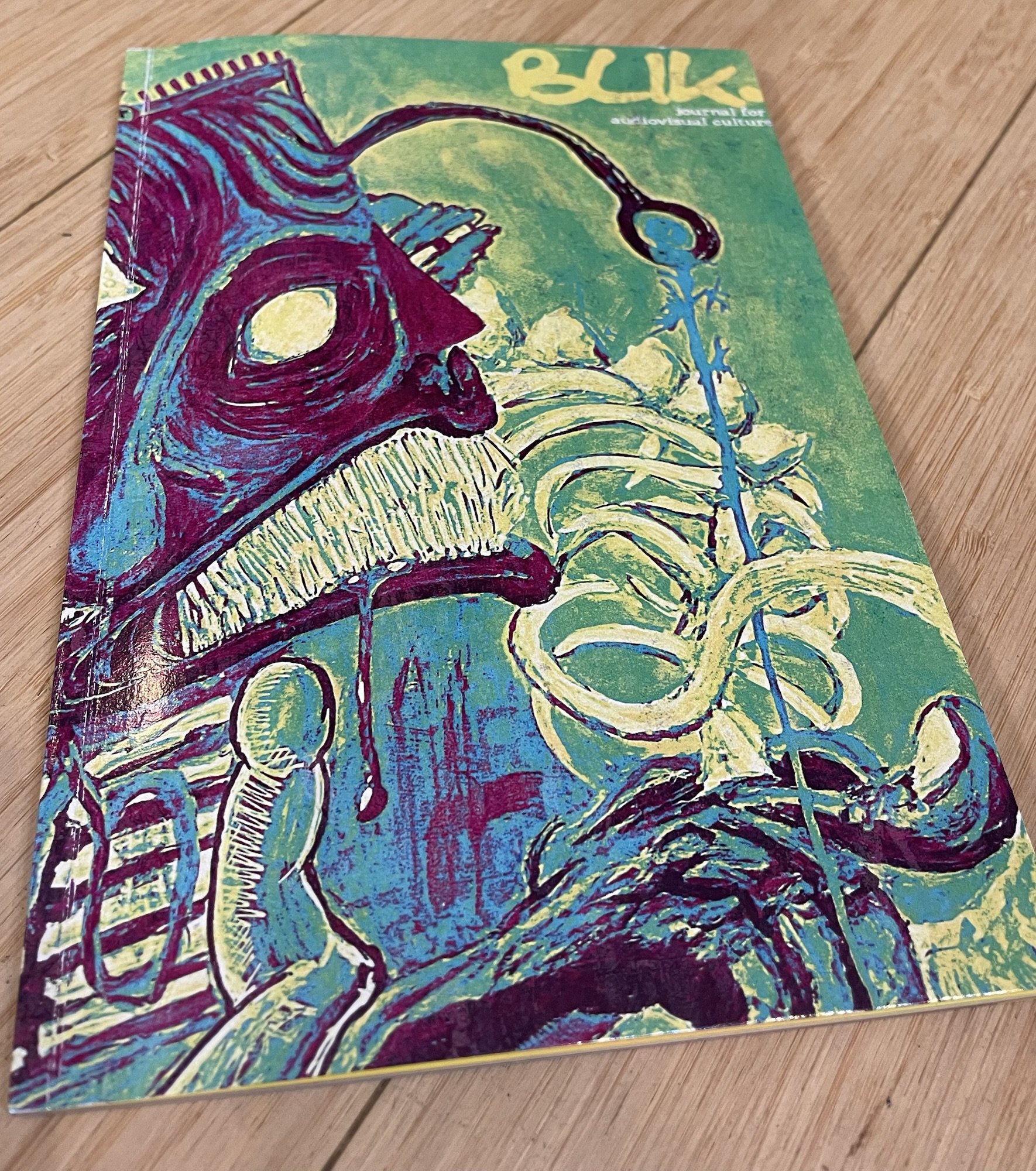
About a year ago, I wrote an invited contribution for Media and Culture student journal BLIK, with the title “Civic Urban Al as a Pedagogical Challenge”. It is bases on the work that I’ve been doing with several colleagues, and that has been published in Mediapolis recently. This week I received this nice-looking hardcopy in the mail. Thanks Alya Khairunissa and BLIK team!
Civic Urban Al as a Pedagogical Challenge
Michiel de Lange
Abstract
With the rise of applications of Artificial Intelligence in urban spaces, cities become further subjected to the logics of digital platforms and Big Tech interests. In this contribution, Media & Culture Studies faculty Michiel de Lange shares how this informs his research agenda about citizen agency and inclusion, and about learning how to live together with Al in cities.
Most of humanity today lives in media cities that are profoundly shaped by digital technologies. Think about the platforms that provide physical and localized services like food delivery, mobility, bookings. Think about how our personal mobile devices are used in various urban settings for communication, watching series on the go, listening to music, wayfinding, tracking steps, and romantic dating. Think about what we usually don’t see when we walk around town: the cables and wireless infrastructures and protocols that transmit vast amounts of digital traffic through soil, water and ether. And think about how governments, businesses and institutions – powered by data and algorithms – quantity, measure and predict many aspects of our everyday (urban) lives.
Not long ago the discussions about media and the city were often framed by the term ‘smart cities’. More recently urban Al is an upcoming topic. In the last few years there has been a surge in Artificial Intelligence (Al) deployment in urban settings. Examples include camera surveillance with image recognition, predictive policing, sound/noise detection, autonomous vehicles and robotics, energy distribution prediction and optimization, traffic optimization, public services using synthetic voice chat, the use of algorithms in welfare schemes, and Al optimized urban planning.
Oftentimes, these Al applications cater to the narrow interests of public administration and/or businesses, instead of serving collective benefits and public values. Current deployments of urban AI overwhelmingly focus on further optimizing mission-specific control, efficiency or consumption, with little regard for wider and more abstract public values. There is a risk of ‘mission creep’ as these specific deployments are stretched and expanded toward broad general-purpose applications. It is well documented how this may disproportionately affect marginalized communities in particular. Meanwhile, public governance structures and procedures, and the institutional trameworks that safeguard public values, frequently are lacking or lagging.
This raises questions such as how can urban Al be conceptualized and designed with civic aims and values like inclusiveness, accountability, and transparency in mind? How can urban AI be (re)conceptualized, developed and governed as civic urban AI? This is a topic I am researching together with colleagues in our University and beyond, including Nanna Verhoeff from the [urban interfaces] research group and Luke Hespanhol at The University of Sydney, and Erna Ruijer and Stephan Grimmelikhuijsen from the focus area Governing the Digital Society, with whom I have organized an expert meeting about this topic.
One of the avenues we are exploring is how to rethink our entanglements with agentic Als and the city. How does the distribution of agency impel us to rethink how we live together in cities? Further extending this line of thinking, we are interested in the pedagogical foundations of this entangled contemporary urban condition. Cities have in urban theory frequently been described as pedagogical spaces where people must learn how to deal with differences and with adversarial events and circumstances. In this view, cities have always acted as agents that spur learning among its inhabitants.
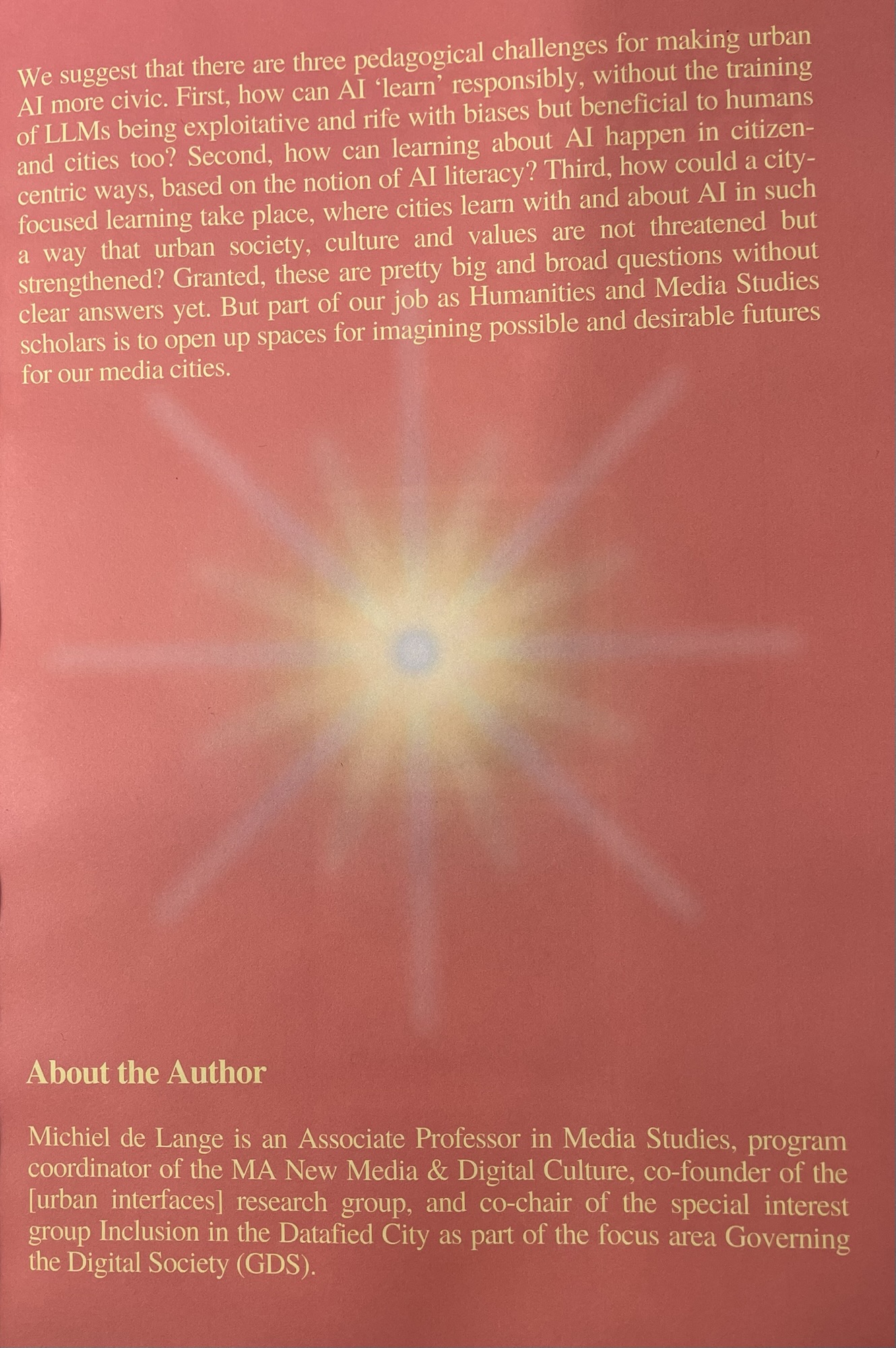
We suggest that there are three pedagogical challenges for making urban AI more civic. First, how can AI ‘learn’ responsibly, without the training of LLMs being exploitative and rife with biases but beneficial to humans and cities too? Second, how can learning about Al happen in citizen-centric ways, based on the notion of AI literacy? Third, how could a city-focused learning take place, where cities learn with and about AI in such a way that urban society, culture and values are not threatened but strengthened? Granted, these are pretty big and broad questions without clear answers yet. But part of our job as Humanities and Media Studies scholars is to open up spaces for imagining possible and desirable futures for our media cities.
About the Author
Michiel de Lange is an Associate Professor in Media Studies, program coordinator of the MA New Media & Digital Culture, co-founder of the [urban interfaces] research group, and co-chair of the special interest group Inclusion in the Datafied City as part of the focus area Governing the Digital Society (GDS).